
Day 2 — AI vs Machine Learning vs Deep Learning

A Practical Guide for Your MLOps Journey
If you’re coming from DevOps, Cloud, or Platform Engineering and moving toward MLOps, this is one of the most important distinctions to get right early.
Most people use AI, Machine Learning (ML), and Deep Learning (DL) interchangeably.
In production systems, that confusion often leads to:
Over-engineered pipelines
Unnecessary GPU usage
Higher cloud costs
Complex deployments where simple models would work better
Today’s goal is to clarify these concepts from a systems and operations perspective, not an academic one.
The Big Picture
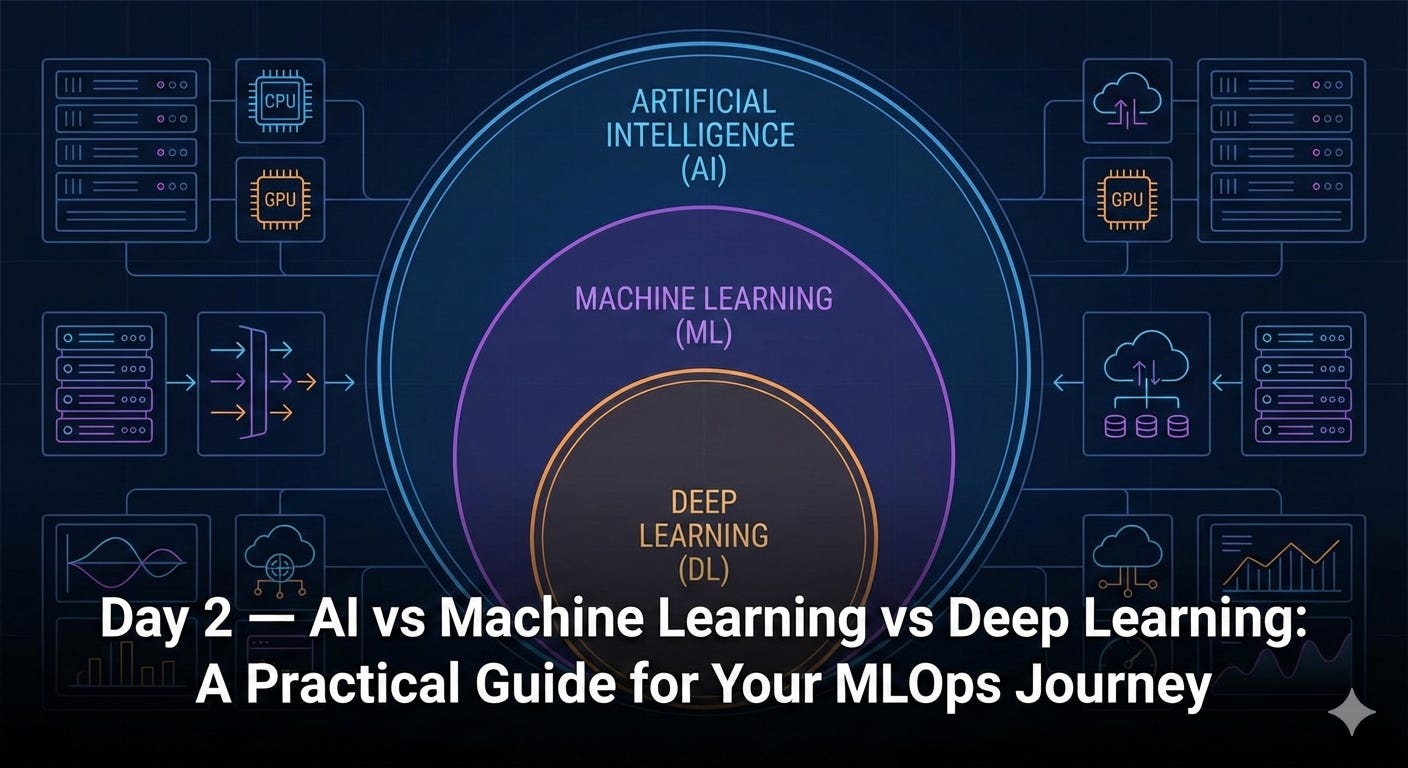
These are not separate technologies competing with each other.
They are nested layers:
Artificial Intelligence (AI)
 └── Machine Learning (ML)
      └── Deep Learning (DL)
Understanding this structure helps you design the right architecture, pipelines, and infrastructure for your system.
What Is Artificial Intelligence (AI)?
AI is the umbrella concept.
It refers to any system that mimics intelligent behavior such as:
Decision-making
Reasoning
Planning
Problem-solving
AI systems don’t have to learn. They can be:
Rule-based systems
Expert systems
Search and optimization systems
Machine learning models
From an MLOps perspective, AI defines what the system should achieve, not how it is implemented.
What Is Machine Learning (ML)?
Machine Learning is a subset of AI that learns from data instead of rules.
Instead of writing logic like:
“If X happens, do Y”
You provide:
Input data
Output labels (or feedback)
And the system learns patterns on its own.
Examples:
Email spam detection
Credit risk scoring
Recommendation systems
Demand forecasting
Why This Matters for MLOps
The moment you introduce ML, you introduce new operational challenges:
Training pipelines instead of build pipelines
Data versioning instead of code-only versioning
Model monitoring instead of service monitoring
Retraining instead of redeploying
This is where DevOps evolves into MLOps.
What Is Deep Learning (DL)?
Deep Learning is a subset of ML that uses neural networks with multiple layers.
It becomes useful when:
The data is large and unstructured
Features are hard to define manually
Patterns are highly complex
Examples:
Image recognition
Speech-to-text systems
Natural Language Processing (NLP)
Computer vision
The Operational Reality
In production, Deep Learning usually means:
GPUs instead of CPUs
Larger storage requirements
Longer training cycles
More complex monitoring
Higher infrastructure costs
DL isn’t just a model choice.
It’s an architecture and budget decision.
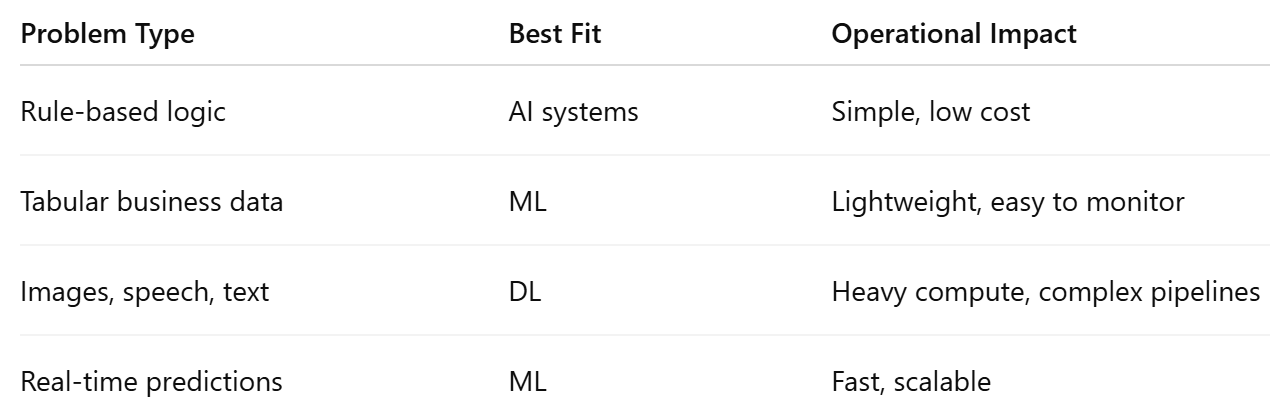
Choosing the Right Approach (Production Mindset)
Here’s a simple way to think about it:
Why This Matters in MLOps
When you choose ML vs DL, you are also choosing:
CPU vs GPU infrastructure
Pipeline complexity
Deployment strategy
Monitoring depth
Long-term cloud costs
This is not just a data science decision.
It’s an engineering and platform decision.
Connecting This to Day 1
On Day 1, we focused on:
What a model is
How learning differs from traditional programming
Why data drives system behavior
Today’s key insight is this:
The type of model you choose defines the entire MLOps architecture that follows.
A Practical Takeaway
Not every problem needs Deep Learning.
In fact, most real-world production systems succeed with:
Clean data
Simple models
Strong monitoring
Reliable retraining pipelines
Complex models without strong operations often fail silently.
What’s Coming Next — Day 3
The Machine Learning Life Cycle → MLOps Pipeline
We’ll walk through:
Problem Definition → Data → Training → Evaluation → Deployment → Monitoring → Retraining
And map each stage to:
CI/CD
Infrastructure
Observability
Automation
This is where Machine Learning officially becomes MLOps.
Follow the Journey
If you’re transitioning from DevOps to MLOps, this series is built for you.
My goal is simple:
Build ML systems that survive production — not just models that work in notebooks.
Resources
📓 Handwritten Notes (ML → MLOps Concepts)
💻 MLOps GitHub Repository (handwritten notes + concepts)
👉 MLOps Zero to Hero