
Online Learning in Machine Learning: How Models Learn in Real-Time - Day5

Today’s day 5 of ML journey on the way to MLOps. Machine learning models used to be like students who studied once, gave an exam, and never opened a book again. But today’s world doesn’t work like that. Data changes every second, user behavior evolves, trends shift overnight, and systems need to keep up.
That’s where Online Learning comes in.
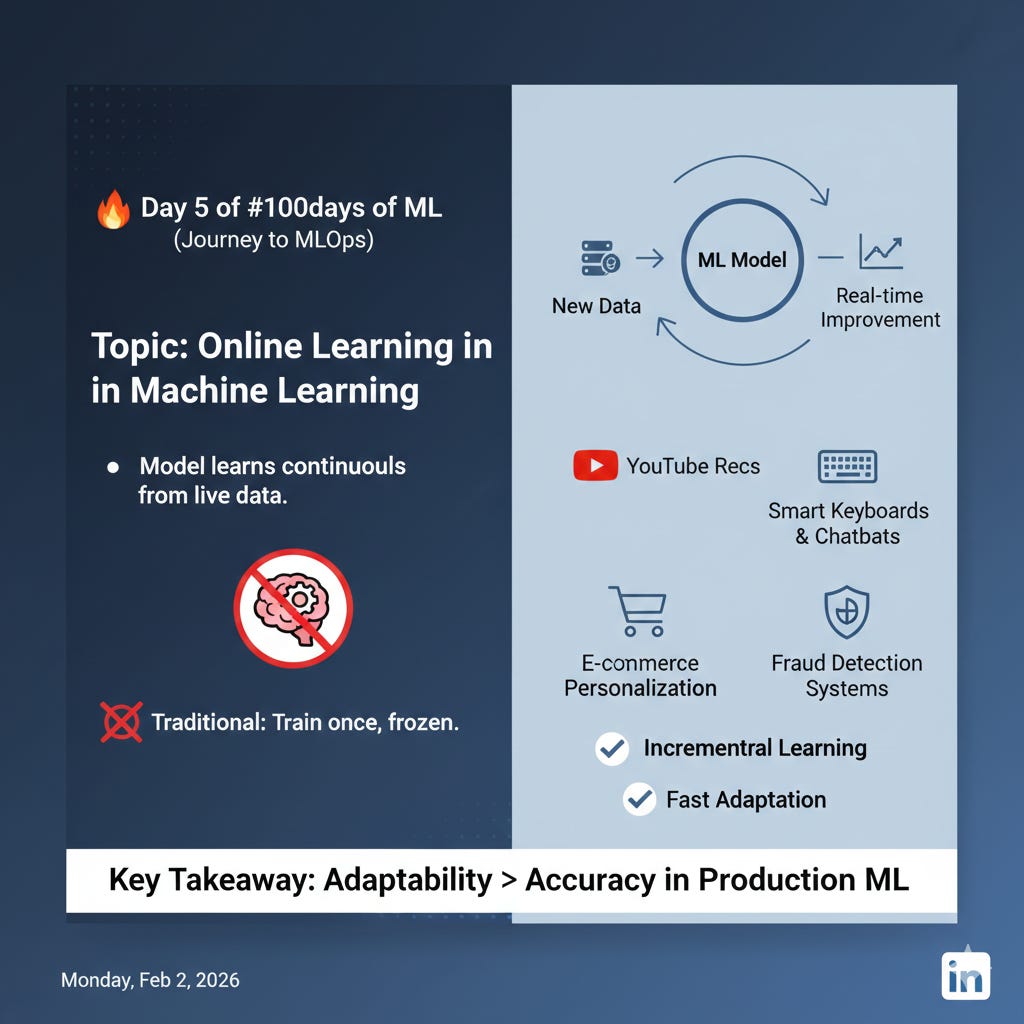
Instead of training a model once and freezing it in production, online learning allows a model to learn continuously from new data while it is running live.
Big Picture First
There are two main ways ML models learn:
1. Offline (Batch) Learning
You collect a big dataset
Train the model one time
Deploy it to production
If data changes → you must retrain from scratch
2. Online Learning (Today’s Topic)
Model learns little by little
New data comes in → model updates itself
It improves continuously while running
Online Learning is a machine learning approach where a model is trained incrementally using small chunks of data that arrive over time, rather than training on a complete dataset all at once.
Think of it like:
Offline learning = study once, take the exam
Online learning = learn every day while workingThe model keeps learning while it’s working.
Every new data point helps the model adjust itself, improve predictions, and adapt to real-world changes.
Simple Definition
Online Learning is when a machine learning model is trained incrementally using small chunks of data that arrive over time, instead of training on a full dataset all at once.
The model:
Gets new data
Updates itself
Gets better
Repeats forever 🔁
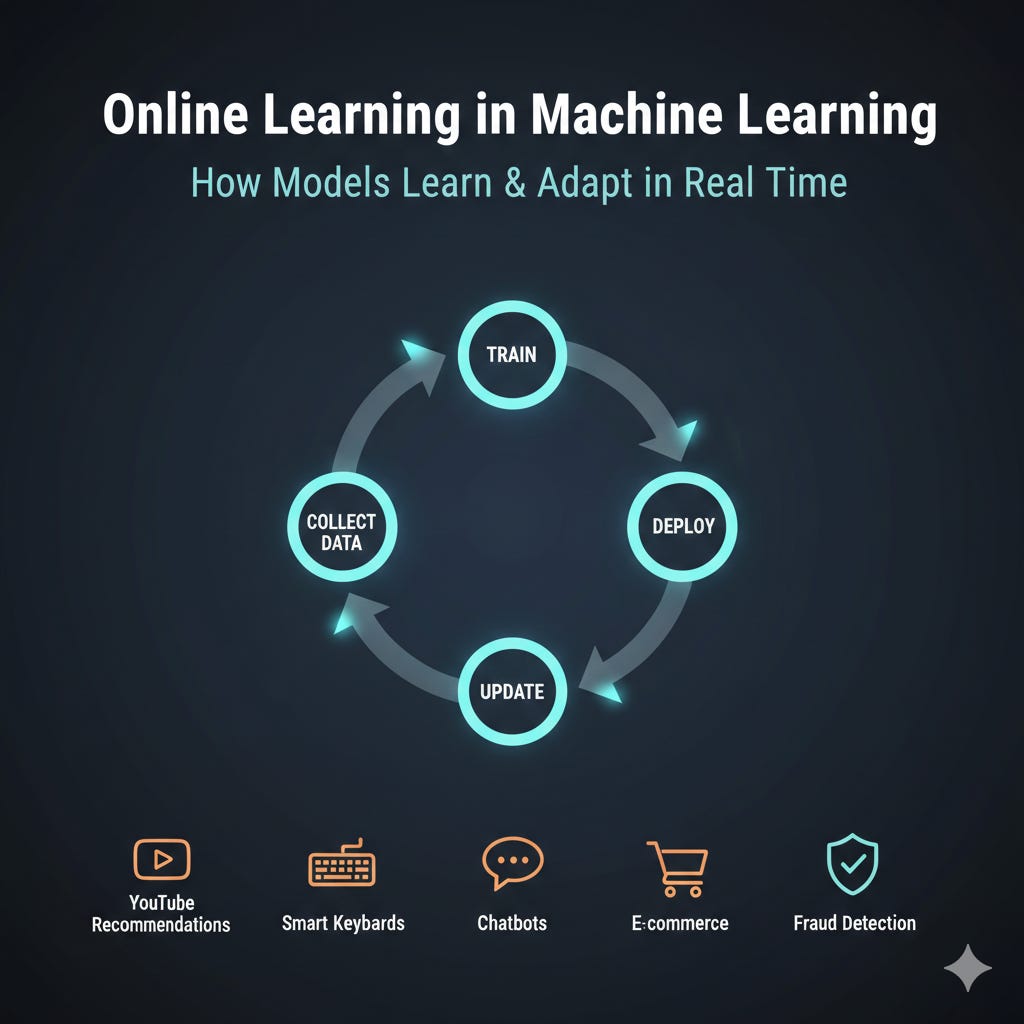
How the Flow Works
Step-by-Step:
Start with some initial data
Train a basic model
Deploy it to production
New data starts coming in (users, clicks, messages, behavior)
Model updates itself using that new data
Performance improves over time
So the model is learning while serving predictions
Real-World Examples (You See This Every Day 👀)
YouTube
You click one video
Suddenly your feed changes
That’s online learning adapting to your behavior
Chatbots (Google Assistant, Alexa, Siri)
They get better at understanding you the more you talk
SwiftKey / Mobile Keyboard
It learns how YOU type
Predicts words better over time
E-commerce (Amazon, Flipkart)
What you click → what it recommends next
Real-time learning from your behavior
When Should You Use Online Learning?
You should use it when:
The Problem Changes Over Time
This is called Concept Drift
Examples:
Stock market
Social media trends
Customer behavior
News, ads, recommendations
If the world changes → your model MUST change too
Cost & Performance Benefits
Why companies love it:
You don’t need massive servers to retrain full datasets
Training happens in small pieces
Faster updates
Lower cost
Real-time improvement
Tools & Libraries for Online Learning
Python Libraries:
River
Built specifically for online machine learning
Handles streaming data
Incremental training
Scikit-learn (partial_fit)
Some models support training in chunks instead of full datasets
Important Settings: Learning Rate
This controls:
How fast your model forgets old data and learns new data
Too Fast:
Model forgets past patterns
Becomes unstable
Too Slow:
Model doesn’t adapt
Becomes outdated
You need balance
Big Advantage
Handling Huge Datasets
If you have:
50GB data
Only 8GB RAM
You can’t load everything at once.
Online learning lets you:
Feed data in small chunks
Train step by step
No memory crash
Problems & Risks
1. Bad Data = Bad Model
If hackers or bugs send bad data:
Model learns wrong things
Becomes biased or broken
2. Hard to Monitor
Since the model keeps changing:
You MUST monitor performance
Detect anomalies
Have rollback systems
3. Less Enterprise Stability
Most tools are still evolving
Not all companies trust online learning in critical systems yet
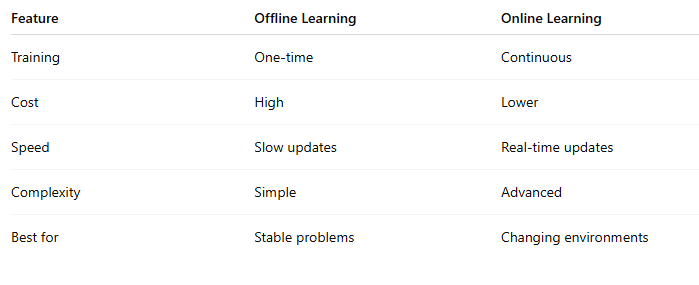
Online vs Offline Learning (Quick Compare)
Final One-Line Summary
Online Learning is a machine learning approach where the model continuously learns from new data in real time, improving itself while running in production instead of being retrained from scratch.
Fascinating. Your explanation of online learning and its continuous adaptation resonates deeply. It's so vial for keeping ML models relevant in our constantly changing data landscape. Really well put.